|
|
|
|
|
Home →
Publications →
True Tracks →
Summer-Fall 1997
|
True Tracks - Summer-Fall 1997
|
|
|
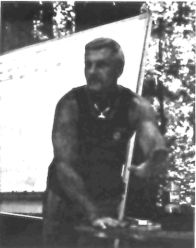
Grandfather Class Rocks
Any new class is a risk, but when the new class is titled,
"Grandfather" the risk has to be diminished. In July, the newest
class on the Tracker curriculum will be taught. In fact, by the time
you are reading this it will be recorded history.
The focus of the class is on the philosophy behind the individual
skills that Grandfather taught. For example, the bow drill fire is
one of the most basic skills. There is a specific philosophy behind
it, how and when it is used, and symbology surrounding its use.
There are also stories -- mythology around its origin. These are the
types of topics that will be covered.
Because of all that Grandfather taught Tom, it will not be
possible to cover all the skills, but there are many stories that
Stalking Wolf told Tom as he taught these skills that Tom will
relate to his students.
Response to the class has been strong, and enthusiasm for the
class is there. Perhaps this may be a class that will be added to
the permanent curriculum. |
|
 |
|
|
|
| |
|
NEWS FROM THE FARM
GREETINGS
Greetings! WELCOME to the sixth edition of the True Tracks
Newsletter! We're all very happy you have enjoyed them so far! Many
of you have called about receiving past issues, but the only extras
we have are from issue #4. If you didn't receive it, call the office
and we will send one. Please - there are no more copies of the first
three newsletters, so we cannot send any. Perhaps you know of
someone who can make a copy of theirs. There are always glitches in
large mailings so we apologize if you haven't received them. Also,
they are available online at the Tracker School website.
CALLING ALL SHADOW SCOUTS
E ach year we allow a limited number of Scout Class graduates to
return as Shadow Scouts to stalk and challenge the skills of the
current Scout students. In order to participate as a Shadow Scout in
next year's Scout class, you must be a Scout graduate, and you must
register in writing with Richard Cleveland. Unfortunately, we cannot
allow drop-ins and non-Scout graduates to participate in the
experience. Every application will be reviewed. Once you have been
selected, you will be sent a set of guidelines that you will be
required to observe. If you are interested, please drop Richard a
line.
CLASS LIST NOTE
It is not unusual to meet up at a class with someone you want to
stay in touch with. If that is the case, make sure to get their name
and number in your notebook - or better yet - make up a class list.
The school respects the privacy of students and cannot give out
addresses or phone numbers.
CALLING NINJA/TRACKERS
Ninja Joe wants to let all the Ninja/Trackers out there know that
Tom and Deb will be at this year's New Jersey Tai Kai July l7th thru
20th. We will also have a Tracker booth there.
CORRECTION
Last issue Seth wrote a wonderful article on Heat and I of course
forgot to give him the proper attribution. So let it be known that
Seth is the author of last issue's articJc on Heat.
WELCOME AND HELLO
Say hello to our new interns - Brian Richard and Dan Stanchfield.
You may remember them as caretaker Dan and Brian. They will be
working as interns and helping the instructors with transportation
and logistics. Say hello to them when you see them.
TRACKER ONLINE
It is now possible to contact the school using email or visit the
School website. |
| |
|
 |
| |
|
| |
|
Tips for a Great Tan
By Hilary Laurer
This article is on the
Wildwood Survival website |
| |
|
|
|
|
 |
| |
|
LIVING COMFORTABLY IN A LONG
TERM SHELTER
by Seth Recarde
This article is on the
Wildwood Survival website |
| |
|
| |
|
 |
| |
|
MOTHER NATURE AND HUMAN NATURE
by NINJA Joe Lau
Many beginning students have very romantic expectations about the
Tracker school. This is, of course, only normal after having read
Tom's stories of his education and training under Stalking Wolf.
Because of this, many students sometimes unknowingly put the Tracker
family under a microscope, longing to see those of us who work here
stalk silently across a bed of dried leaves. I remember coming to
the school with these expectations myself.
It is in this frame of mind that many will miss some main points
of the lessons taught here. Tom is very well known for saying, "Kill
the White Winged Buffalo." Meaning, many students come to the school
with their head in the clouds looking for a spiritual sideshow. Our
way however, is to have students create their own "miracles" by
helping them create a solid foundation with their feet firmly on the
ground.
The ancient skills are the starting point. The spiritual benefits
of the physical skills begins in the feelings of "oneness" that are
activated by them. It is the deeper understanding of humans'
relationships with the natural world on a level that cannot come by
logical analysis, only by experience.
Our physical/spiritual relationship with the Earth is very
distant since we no longer live a hand-to-mouth existence in nature.
We are also no longer living in close knit tribes and clans. Our
physical spiritual relationships with each other as human beings
seem just as distant. Many times we get disgusted with each other's
behavior. "Environmentalists" especially sometimes seem to turn into
human haters. You should know that the people who make up the
Tracker family live normal lives without fantasies of running into
the wilderness to forever avoid the disappointments of society.
Years ago, I too had to re-clarify my perceptions that there is a
balance possible between living in nature and living in society. It
is the school's vision and purpose to teach others to find this
balance between society and nature.
In my last article, I wrote about Dr. Robert L. Humphrey's dual
life values theory of self and others. "Others" seem to have a
slight edge over "self." It would seem as we look at the world that
we are self-preservers. However, as Budo Taijutsu (martial arts)
teacher Jack Hoban said in his article "Human Nature and Mother
Nature", when it comes down to a matter of life and death we tend to
value "Women and Children first" over "Every man for himself." We
call a person who saves himself a survivor, while we call the person
who saves others a hero.
In my opinion, these same self preservation and species
preservation values are found in nature. Have you ever accidentally
disturbed an ant's nest? What is the first thing they do? They grab
their eggs and take them to safety and protect them. Animals can
have instinctual species preservation values to help protect against
Mother Nature's "survival of the fittest." But in humans, we seem to
honor most those who protect the weak. Maybe Human Nature is the
choice of the two values -- of having the courage to choose others
over self.
I feel that when one studies the ancient skills, one should practice
with the feeling of "providing life" rather than "I am ready to take
on any wilderness situation." I feel this is a more enlightened view
and to me it simply feels better. Try it if you don't believe me.
Because of the skills we carry inside, as Dr. Humphrey says,
"Wherever you go, everyone should be safer because you are there,
and everyone in need has a friend." Maybe in the past, some of us
have been guilty of thinking, somewhat self-importantly, that "I'll
get by even if he/she doesn't." To me this doesn't feel as good. Not
everyone may know it, but I believe many will pick up these vibes
unconsciously.
So practice your skills - not to run away, but to have the
awareness, knowledge, and experience to be a better human being for
other human beings. |
| |
|
 |
| |
|
| |
|
NEWS FROM ASSOCIATES
TRACKER CONSULTING MAKES HEADWAY IN CORPORATE
WORLD
by Kevin Reeve
We are pleased to announce Tracker Consulting -- a
company dedicated to bringing the wilderness teachings of Stalking
Wolf into the corporate arena, has successfully worked with two
large clients.
Our vision is to create companies that are both
profitable and sustainable (sustainable means that there is no
utilization of nonrenewable resources or generation of
non-recyclable waste). We believe that if we can influence the
leaders of corporations, those who make decisions about resource
consumption, and reconnect them with the earth, then we can have
significant impact.
Our first major client is Xerox. Working with the
Xerox Management Institute in Leesburg, VA, we taught a four day
class, held in Sedona, Arizona. Twenty five senior level (Director
and above) managers participated. The students learned awareness
skills that are easily applied in their organization.
They learned to fox walk, stalk, and use wide angle
vision as a metaphor for how they pay attention in their own
organizations. The also made fire using a bow drill. However the
spindle was a 4' section of telephone pole and the bow was a 18'
long fence pole. This giant size bow drill threw out a coal the size
of a charcoal briquette. The students were truly amazed at their own
accomplishments.
We will be working with other companies, including
Barclays Bank in the UK and several high-tech firms.
Tracker Consulting is headed by Kevin Reeve, Bill
Horrocks, and Michael Popowits.
EARTHWALK NORTHWEST, INC.
FRANK & KAREN'S SKILLS CLASSES
P.O. Box 461, Issaquah, WA 98027
(206) 746-7267
1998 Classes will include:
. Four day Herbal Studies Course
. Advanced Skills Course
. Wild Edibles Weekend
. Big Frank's Brain Tanning, Primitive Skills, & Wild Gourmet Foods
Course
. Brain Tanning II
. Skills Refresher Course
. Edible Vegetable Course
. Log Cabin Building
. Primitive Bow and Spear Fishing
. Semi-survival Treks
To Register, please call.
EARTH-HEART
The purpose of Earth-Heart is to help people to clarify and progress
in their personal and spiritual development. We recognize the unique
challenges each individual faces on their life 's path, and seek to
design programs tl1at respond to those individual needs. We offer
the following programs: Personal Intensive, a six day program to
address specific personal or spiritual issues in your life;
Spiritual Retreat, a two week course to clarify and deepen
understanding and experience of the spiritual path; Bridgeworks, a
one week course focusing on living our vision in daily life and a
Vision Quest program. |
| |
|
 |
| |
|
| |
|
 |
| |
|
CHILDREN
by Richard Cleveland
Children are perhaps the greatest gifts the Creator ever gave us.
And as adults perhaps our greatest challenge. It's so easy to get
caught up in ourselves and our daily routine. It's no wonder that
spending time with our children often goes by the way side.
I remember when I was growing up, often hearing the cliché "the
future is in our children." At the time I don't think I truly
understood or appreciated how important and powerful that statement
really is. After all, I was too busy playing, partying, and trying
to control my hormones then to be concerned about children. In fact,
children kind of annoyed me most of the time.
I guess the change happened when I was about 30 years old. I
started playing more with my brother's children, and suddenly began
seeing the future through their eyes. After all, I wasn't going to
live forever and I couldn't take all those fishing poles and
sporting goods (that I hardly ever used) with me when I died anyway.
I suddenly realized that up till then my life totally revolved
around me. And I noticed that I really hadn't gotten a whole lot
done anyway. I hadn't done much of anything to try to leave this
world a better place for future generations.
I realized then that it was the children who were going to
inherit this earth, and it was and is our responsibility as adults
to make sure that we teach our children to love nature and learn to
live with it. And immerse them at an early age into all the beauty
and wonder that our great planet gives to us. To give them that gift
at an early age is so important to the future of our planet. A gift
that too few of us had when we were young. Hopefully then they will
make better decisions in their lives than we made. And hopefully the
destructive trend that human kind has followed thus far can be
turned around forever. It's not too late.
Students often ask me what and how I teach children at my
programs here at the school. I can tell they're a little surprised
at how simple I make it sound. Well the truth is, it is simple. I
teach kids the four most important elements of survival: shelter,
water, fire and food. Then I mix in a bunch of awareness exercises
and a little spiritual stuff. Over all I get them as dirty as I can
and have as much fun as possible. And hopefully I'll plant a few
seeds.
I don't have a degree in child psychology and I don't teach from
a text book. I teach straight from the heart, and I am able to
adjust and adapt at a moment's notice. And it's a lost more fun this
way. My advise to people who want to teach kids, but are a little
afraid, is to jump in feet first and go for it. Any teaching is
better than no teaching at all. And besides, they'll teach you more
than you'll teach them anyway. So have fun.
A friend of mine sent me a card that pretty well sums it all up.
On the card there is a picture of a little boy standing on the shore
of a lake, gazing out across the water. The card is entitled
"PRIORITIES" and it says" A hundred years from now it will not
matter what my bank account was, the sort of house I lived in, or
the kind of car I drove, but the world may be different because I
was important in the life of a child." There are a lot of children
out there waiting for someone to make a difference in their
lives...maybe it's you! . |
| |
|
| |
|
YOUR HELP IS NEEDED !
by Seth Recarde
The number of people attending the classes at the Tracker School
continues to grow. This has created a need for volunteers who have
taken the Standard course to act as visiting instructors for
upcoming Standard courses.
Your primary responsibilities will be to help us in preparing for
the classes and in working with the students. This includes giving
general help, especially during workshops and meal breaks, and being
available to answer student questions and assist them with skill
practice. It is a great opportunity to review the Standard class
materials, and is great fun as well.
We are looking for Standard course graduates who have practiced
their skills, who relate to the students in a caring and positive
manner, and are willing to give us a hand. You can sleep in a tent
or the barn, and best of all you can eat stew with the class. So
pack as you did for the standard, but bring all those extras you
wish you had last time, (like a thick cushion to sit on) and join
us. It will be fun to have you here.
We are also accepting applications for volunteer instructors for
the advanced classes. You must have already attended the class as a
student and be proficient in skills and techniques taught. If you
are interested, fill in the form below and send it off. We will get
back to you as soon as we can confirm your dates. |
| |
|
| |
|
 |
| |
|
SCOUT MARTIAL ARTS
by Paul Bonner
Dates have been set for the 1997 Scout Martial Arts class. This
year's class will be held October 6 - 11, 1997 in the Pine Barrens
Primitive camp. This year Tom will be participating, teaching
Grandfather's martial philosophy and martial games as it relates to
the Apache scout. Prerequisite for Scout Martial Arts is Scout.
Class will be taught by Paul Bonner and George and Vanessa
Larson. Paul has been teaching at the Scout class since 1989 and
George and Vanessa since 1992. All three are Tracker graduates and
have been through Scout. Paul Bonner specializes in Philipino
Martial art of Kali, and is certified under Dan Inosanto and Rick
Faye. In addition, he is certified in JKD concepts (Bruce Lee's
concepts), Muay-Thai boxing and Wing Chun, Maphilindo Silat, Kenpo
and jujitsu. He is also certified by World Heavyweight Shoot
Fighting champion Bart Vale. Paul teaches law enforcement of all
types from recruits, to tactical teams and drug enforcement agents.
George and Venessa Larson are also certified by Dan Inosanto to
teach Philipino and JKD. They train under Rick Faye in Minneapolis. |
| |
|
| |
|
 |
| |
|
TRACKER WILDERNESS EXPERIENCE
by Kevin Reeve
By the time you are reading this, we will have completed our
first pilot of the Tracker Wilderness Experience. For those of you
who have not heard of it, the Wilderness Experience is an
opportunity for Back-to-Back graduates to practice full wilderness
living in a less intimidating situation.
The program is designed for a small number of participants to go
into the wilderness with a knife and a blanket for a week. Class
size is limited to 32, and participants are formed into groups of 8.
Each group has a pair of instructors assigned, so the ratio is one
instructor to four students.
The emphasis is on living the sacred order. The first days are
spent making shelter, finding sources of pure water, making fire,
and finding sources of food. Besides gathering edible plants, we
will do non-lethal trapping and hunting, and will supply canned meat
for those who successfully take an animal in a non-lethal trap or
who" count coup" on an animal they stalk. The rest of the week will
be spent perfecting skills and learning new approaches to existing
skills.
Since Tom is not participating directly we are able to offer this
experience at many locations around the country. The pilot in July
will be held in upstate New York, and a second pilot will be offered
in September in California on property adjoining Yosemite.
Since the number of advanced classes is limited in 1998, we will
offer several regional opportunities for the Wilderness Experience. |
| |
|
| |
|
 |
| |
|
| |
|
 |
| |
|
FROM THE MAILBAG
by Kevin Reeve
I have a computer. I am also connected to the Internet. There are
many advantages to being online. One of the greatest for me has been
the new friends I have made on the Tracker listserver. The Tracker
listserver is not affiliated with the Tracker school in any way, but
it has provided a forum for Tracker students to meet and discuss
Tracker related issues on-line. It provides great freedom for
discussion and opportunity for folks from around the country to
learn.
One of the things that has come up consistently on this forum is
the perception that exists out there in the primitive skills world
that some Tracker students have a lot of book knowledge, but little
dirt time. They have a tendency to rely on Tom's knowledge about a
given skill rather than making it their own.
This criticism does not apply to everyone. In fact, I believe it
actually applies to very few. Most of the students I know are
serious about perfecting their skills and work hard getting dirt
time. However there are some for whom a Tracker class is strictly an
academic experience. They take notes furiously, and then stick their
notebooks up on the shelf and leave them there. They can talk a good
talk, but when push comes to shove, they haven't walked the walk.
Perhaps Tom makes these skills too easy for us to obtain. Perhaps
some miss out on the Coyote. (If you haven't tried the traps you
learned in your Back to Back, by the time you get to Scout, it will
be obvious -- the information is not always complete, something you
won't discover till you try it.) My point is that book knowledge is
great. Knowing ABOUT how to survive and actually surviving are two
different things. The challenge is mastering our skills, not our
knowledge. |
| |
|
Please
see the Site Information & Copyright Page
|
|
This website has no official or
informal connection to the Tracker School or Tom Brown Jr. whatsoever |
|
|
|
|
|
•
•
•
•
•
•
•
•
•
•
•
•
|
|
|
|
|