Tracker Trail
A website about Tom Brown Jr. and the Tracker School

For Wilderness Survival and Tracking visit the Wildwood Survival website

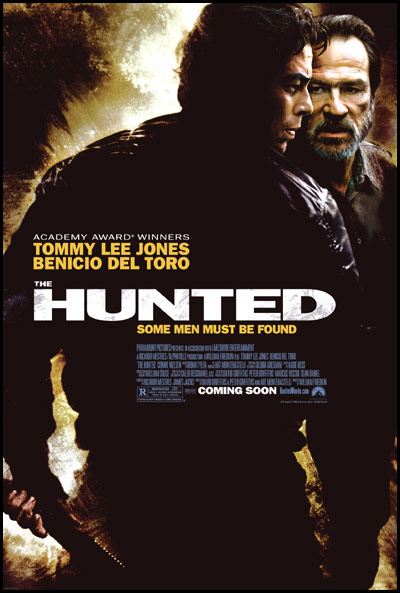
"The Hunted"


Overview
 
The Hunted

Director: William Friedkin
Technical Consultant: Tom Brown, Jr.
Distributed by: Paramount Pictures
Theatrical Release Date: March 14, 2003

The story of an FBI "deep woods tracker" who captures an assassin who makes a sport of hunting deer hunters in the forests outside Portland. When he escapes in the city, the tracker must team up with a female FBI agent to hunt the assassin down before he comes hunting for them.

Both characters in this movie are based, in part, on the life and tracking cases of Tom Brown Jr. The Tracker Knife, also makes an appearance in the movie. A scene showing the flint knapping of a blade actually shows the hands of Tom Brown.

Cast:
Tommy Lee Jones, Benicio Del Toro, Connie Nielsen

The Hunted website  (http://www.huntedmovie.com/home.html)


A message from Tom Brown Jr. about this movie
  

I am happy to report that "The Hunted", starring Tommy Lee Jones and Benicio Del Toro, a Paramount Pictures film that I was the technical advisor for, will make it to the big screen on March 14.

By now, you may have read about the movie. If not, you will very soon. The featured article in the Spring 2003 True Tracks focuses on the movie and my involvement with it. I am proud to say that many of the skills we teach at Tracker School, such as tracking, hand drill, stalking, camouflage and more - are prominently highlighted in the film. I especially enjoy a scene in the movie when the Tommy Lee Jones character saves a wounded wolf.

As the technical advisor I worked very closely with the director, Billy Friedkin, to ensure the authenticity of the survival skills showcased, as well as other aspects of the movie, including those scenes involving knives.

I also need to remind you that the movie is Rated R for violence, and ask you to keep in mind that while I was the technical advisor and that the Tommy Lee Jones character is based on me, the director determines the ultimate flow of the film.

I like to put it this way. I created the colors of choice for Billy Friedkin, who then designed and painted the picture.

Enjoy the movie!

-- Tom Brown Jr.


Two brief clips of Tom talking about the movie

Both clips are in MOV format (requires Apple Quicktime)


Interview with Tom Brown Jr. about The Hunted
  
From Bullz-eye.com Movie Reviews 
(http://www.bullz-eye.com/mguide/the_hunted/interview_tb.htm)

Matt Saha, along with other members of the press, recently sat down with Tom Brown, Jr. to talk about "The Hunted." Tom Brown, Jr. is a survivalist and tracker who served as technical advisor to the film and as role model for the Tommy Lee Jones character, L.T. Bonham. He has been in the business for 25 years teaching people throughout the United States about survival and is the successful author of such books as The Tracker.

Press: How did you get involved with "The Hunted"?

Tom Brown, Jr.: Billy Friedkin and I go back about a decade. He was originally gonna make a movie about my life -- we worked together and stayed in touch. He started "The Hunted" and asked me to give Benicio and Tommy my skills. So I started with the metaphor of the knives. If you notice, Tommy has a stone knife, which says a lot about the man. He is primitive and a survivalist much like I am. I teach people to go with nothing and build everything ground up and I gave Benicio the tracker knife, as his character is not as adept in the woods as Tommy’s is.

Press: The tracker knife is your invention. How did you come to design it?

Tom Brown, Jr.: An old reporter asked me if I had to take only one tool from civilization into the woods what would it be? I said a knife, so seven years and thirty prototypes later you have the tracker knife -- anything for any situation -- it can be used as a saw, a skinning blade, it is perfectly balanced so you can throw it like a tomahawk. Unfortunately in the movie you see only 2% of its applications, the rest of the time you see it as a fighting device.

Press: Was the story line in the film close to your life?

Tom Brown, Jr.: The story line is fabricated, but parts happened in my life. A guy I trained went bad and I had to track him down and that is the toughest because when you are tracking someone who knows your skills you start playing a deadly chess game.

Press: Did you find the guy?

Tom Brown, Jr.: Yeah, he found me. I got shot in the back. I realized the mistake at the last minute, but it was nice because the bullet neatly passed through me without doing much damage. He shot me and I hit him hard. He was a military guy and then CIA and then he hired out to other countries. They blamed me, so they said go find him.

Press: Are the tracking skills depicted in the film realistic?

Tom Brown, Jr.: All the skills are true. Friedkin first had to see everything in reality before he did it in the film. I taught Tommy how to make a stone knife. The camouflage, the stalking and the tracking are real, but then there are the latitudes that movies take that pisses me off. I mean I can teach a beginning student how to track a wolf that has a trap on it, and to dig down in the snow to find a winter rosette that can be chewed into a poultice that can be used as an antibiotic, but you are not going to get close to a wolf in that state in 2 minutes, maybe 2 months, yes. And the bloody knife fight at the end -- no way it would last 4 minutes, any of those wounds are lethal. I wanted to be proud of the film, but I made the paint, I am not the artist, the director is, and the finished product is his.

Press: How much can you teach someone off the street about survival?

Tom Brown, Jr.: Well there are 36 levels to my classes. In the basic class, after a week I can teach you to survive with nothing. I will teach you to be more aware than you have ever been in your life and to be able to track a mouse across a gravel driveway. It is so easy to teach these skills, if you know what to look for. Here we have this saying, “survival of the fittest,” that works for animals, but for humans it is what you know.

Press: You used to train military personnel, but supposedly you left out of guilt, what happened?

Tom Brown, Jr.: I stopped training the military for awhile. Most of my classes are general public, but I did train elite military groups. I thought I was teaching them how to evade, escape, like downed pilots behind enemy lines, but I found they were using this stuff to become more efficient killers and that created a moral dilemma in me. Only with 9/11 did I come back to that because my brother-in-law was the first flight officer on the United flight that hit the World Trade Center, and I realized then that enemy now was far different from the enemy of the past. But we screen candidates very carefully. I don’t want to train hired assassins.

Press: How about the killing training in the movie?

Tom Brown, Jr.: I went through the same dilemma as Tommy. I didn’t say stab here, here, and here, but where he says most people who he killed didn’t know he was in the same room as him -- that’s what I do.

Press: How did you start out in tracking?

Tom Brown, Jr.: My best friend -- his grandfather was an 83 year old Apache, from the Southern Lipan peoples in Northern Mexico. I met him when I was 7 and for nearly eleven years, I picked his brain. He became my best friend and he possessed everything I wanted to know about the wilderness.

Press: Do you use Native-American traditions in your training?

Tom Brown, Jr.: Yes, some of my classes demand use of the Native-American philosophy. Like the pressure-release system which he taught me -- it is miniature landscapes found inside a track and each little feature depicts a body function. His people identified over 4,500 of them.

Press: There is an interesting comment in the film, the Del Toro part says to the hunters -- are you guys tough, you need those big guns? And he uses a knife, is that your philosophy?

Tom Brown, Jr.: Right, you pull off a gun in the woods and everyone knows where you are. Funny story down in South America -- they gave native peoples a rifle to kill monkeys and when they came back a year later only two bullets had been used and they asked why. The tribe said they killed one monkey and it chased the rest away. To me a lot of times a gun is a liability.

Press: Are you a hunter?

Tom Brown, Jr.: No, only when I have to in extreme need.

Press: If you sent somebody in the woods with only one thing, what would you give them, string, matches?

Tom Brown, Jr.: I wouldn’t give them anything. There are 23 different ways to make a fire without matches. You could find everything out there -- bones, stone. It gives them freedom and proficiency.


Article from True Tracks about The Hunted
  
Paramount's 'The Hunted' called upon Tom Brown for expertise, authenticity

By Dan Hirshberg

When "The Hunted" hits movie theaters nationwide on March 14, Tom Brown, Jr. can bask in the knowledge that he played an integral part in making this the most authen­tic film ever about tracking and sur­vival.

"The Hunted," a Paramount Pictures release, is about a top spe­cial-forces assassin (played by Benicio Del Toro) gone amok. His mentor, played by Tommy Lee Jones (a Tom Brown-like character), is brought out of retirement to help locate and capture his former expert student. The film is directed by William Friedkin ("The Exorcist," "To Live and Die in L.A."). It is rated R for strong bloody violence and some language.

Brown spent nearly a year in the Pacific Northwest working as a Technical Advisor to Friedkin.

"Billy and I go back many years," noted Brown. "Initially he wanted to make a movie about my life - that's how we met."

Indeed, Friedkin had been dreaming of making a film like "The Hunted" ever since he formed a friendship with Brown, but was con­cerned it would be too much like a documentary of Brown. And then he read a script by David and Peter Griffiths about a trained, Delta Force-style assassin who becomes a serial killer. That script became the basis for "The Hunted," which was rewrit­ten to focus more on the inner and outer conflicts of the Jones and Del Toro characters. Friedkin then per­sonally recruited Brown to train the actors and serve as a consultant throughout the shoot.

"The basis for the movie is very similar to a tracking case I had once been on," said Brown. "At first, I helped with the creating of the story idea. And then I was brought on as a Technical Advisor and from there it branched out, from assisting with things like character development, dialogue, set decorations, special effects and of course, skills training.

I was generally always next to Billy during shooting and that's because he wanted a certain authenticity that I brought to the movie. Billy's a per­fectionist. I've always liked that about him. He's constantly striving to make a story as authentic as humanly possible."

The movie is action-packed with excitement, but does not follow the usual shoot 'em up theory. Instead, the film focuses on survival tactics and features knives, not guns, as the weapons of choice.

In fact, the flint and steel knives used in the movie were cast in hard rubber from originals that Brown manufactured for fight scenes between Jones and Del Toro. Interestingly, an all-purpose knife designed by Brown that is currently for sale through The Tracker School, is prominently showcased in the movie.

Brown spent a great deal of time with both Jones and Del Toro, training them for their parts.

"Tommy Lee has a ranch down in Texas,” said Brown, who was assist­ed in the training by Tracker School instructor Bill McConnell. "There wasn't much training I had to do with him because he's already a hunter and good in the outdoors. Benicio was less experienced, but at the same time extremely easy to train. He spends a lot of time early in the movie in natural camouflage - mud, leaves, sticks. The camouflage was so good that we had to lighten it up so the cameras could see him."


Reviews by Tracker students

There was some question as to the degree to which Tom Brown had left his stamp on this movie, but I do not feel that Tracker students will be disappointed in any way. My opinion is that Tommy Lee Jones must have spent a lot of time with Tom on the set as his portrayal is right on the mark. You can see it in his mannerisms, the way he walks and talks, and even shows off a little of the famous Tom Brown temper near the beginning. Of course its not 100% Brown, but you wouldn’t expect it to be.

Tracker students will see a whole other dimension to this film. Tracking sequences are excellently done with direction of attention through photography so you can see the details of the tracking process. I’m sure the general public won’t notice a lot of things that are in the images that flash on the screen (and I can’t wait to get a DVD version so I can freeze frame some of them). "Inner Vision" is dealt with subtly and respectfully (-again, something the general audience will miss). Hand drill fire, flint knapping, stalking techniques, fox walking, empathy for animals... -Tom’s mark is all over this film. Much more so than I really expected. I found the fight scenes to be very realistic, unlike so many martial arts scenes.

Definitely worth seeing -- worth seeing twice if you are Tracker trained. 8/10

...Oh, and the web site is pretty good too: http://www.huntedmovie.com/home.html

Review by Peter Wiinholt, Tracker student from Ontario


Keep your eye open for some of the traps that are set, and ask yourself, "where is the tension that would cause the trap to spring?" "what is the trigger set with?" I will have to watch again and see if I can spot this but I missed it the first time out.

Other questions to ask yourself: How long does it take to flint nap a knife? Why build a monster mammoth crushing trap when a leg breaker would suffice? How do you heat iron hot enough to forge with a campfire and no bellows in sight? I will have to look for a bellows next time I see it. And if you're being hunted do you really want to be banging away on a rock with iron and iron forging a knife? Makes lots of noise last time I was in a smithy.

On a less technical note, I thought the movie would have been strengthened by showing more background as the tracker taught his students. The psycho student regarded Tommy Lee as a father...they could have shown how that relationship developed. In doing that, they could have added many more little tracker type scenes such as pressure releases in tracking, how to track, become the animal, meditation, inner vision. They could have shown the forging of the bond between the two and perhaps explain why Tommy Lee tried to push it all behind him, even when it came at the expense of a "son". I think the movie had a chance to really delve into the characters and the relationship between them, and in the process, show some more tracking/survival type material.

In doing so, it would have made other parts of the movie more accessible to the average viewer. For example, people are wondering how Tommy Lee managed to track his quarry on city streets and know when the quarry had doubled back, all without leaving a track on concrete. If they had had a 30 sec-60 sec clip on inner vision previously in the movie, this would have explained how he knew. As it was, tracking was just something you did and was not something you lived (which as Tom has pointed out again and again, you live tracking, you don't just do it).

Still, I enjoyed the movie, and having taken 4 of Tom's courses, there is a lot more you can see than the average viewer would. I thought the brief clip of Tommy Lee talking to his new recruits in a flashback was great as he was wearing a tom brown mustache, and he had Tom's "attitude" (for better or for worse :-)

-- KC


I saw the movie last night and I really commend Benicio and Tommy for their knife scenes...I didn't get to see much stalking, though, which was a bit disappointing. I did like the parts where they showed the two characters making their own knives; keep your eyes open for Tom Brown's hands when he's making the stone knife....I also liked the parts where Tommy was training Benicio...I definitely recommend everyone go see this movie...

-- DR


I saw the movie Saturday night........I thought it violent too, but I picked up alot more of the spiritual, skills,and teachings of Grandfather. I especially liked it when Tom's character (the good guy) used "spirit" tracking and when you could actually feel his pain when he had to kill his student. 

I also felt the pain of the "bad guy" when he suffered the original trauma of the war and the confusion and
turmoil his mind went through as he tried to protect the animals he had learned to be brothers with....and for anyone that has taken the Scout Protector Course, there were palpable moments when you could really see del Toro "let the animal run"....did I notice the "good guy" let that animal out to run, that was when
he had to kill his student. I think Tommy Lee did a fair job of portraying TB, but I have never seen TB be as figity as Tommy Lee portrayed him........but then I have never seen TB when he was on a case either.
I do wish that the Tommy Lee character had done more with camoflage and more "stalking". The fast pace
through the forest was a bit noisey (cant imagine TB being so noisey), but, as you say, it was HOLLYWOOD. 

I guess I was a bit disappointed that there wasnt MORE of TB in the character.........I would LOVE to see a
movie about TB.....not just a hollywood film based on aspects of TB.

-- SP


I saw "The Hunted" last nite. While I was not very impressed with the movie, that didn't disappoint me, as I am not a big fan of Hollywood action movies with their excessive violence & ridiculous plots, this film being no exception. What I was disappointed with, though, was that primitive / survival skills played a much smaller role in the film than I was expecting, and with the exception of tracking, the skills were all used by the "bad guy" & shown in an extremely sinister way. Tom Brown is named very prominently in the credits, but I left the cinema with a feeling that the film will not be a benefit to Tracker School or getting Grandfather's skills "out there" to the public. 

However, there was a very positive review of the movie today on National Public Radio. They talked about Tom Brown's legacy and how he provided expertise in making the skills look authentic on screen. The movie reviewer even went to the length to go tracking with Tom and spoke glowingly of him & his skills, recording a brief sound clip of Tom pointing out a nearly-invisible deer track in dead leaves. Check it out, you can hear the review by going to http://discover.npr.org/features/feature.jhtml?wfId=1193447, and click on the icon that says "Listen to Weekend Edition - Saturday Audio". The review left me feeling that even if the movie was not that great, this kind of publicity could be very beneficial to Tracker School & all it stands for.

-- BB


Just saw the movie and thought it was awesome! The fight scenes were incredible. I thought TL's character was pretty cool; I liked him more than I expected to. 

I had high expectations and was not disappointed. I plan to see it again soon now that I know what happens. I want to look for the details, especially in the tracking scenes.

-- TC


Quite the movie!!

I would just state the obvious: there seemed to be a real tension between down to earth traditional skills like tracking, fire, knive making, love for animals---VERSUS---the violence of knife fights, combat and lots of blood. The tension seemed most present within the hunted person (his name--Erin?) as he had the gentleness of teaching a child to track squirrels but also the quick reflex of killing anyone in his way (otherwise nice guy in a bad circumstance and mental state). Definitely worth seeing for those interested in the traditional skills--trackers will pick-up on the little things others would miss -- although the tracks were made obvious enough for the bigscreen. 

I hope there are more movies in the future like this--of course, with more emphasis on the traditional skills and tracking.

--CC


I finally saw THE HUNTED tonight. My overall impression, honestly, is that it was awesome. Yes, it was extremely violent and Hollywood in the extreme, but the skills were there on the silver screen for all to see and wonder about. The paralells between the Tommy Lee Jones Character and TBJ were pretty obvious to me, a Veteran Tracker Student, but I doubt that most of the general public would have any way of knowing who or what the film was really about (beneath the surface). The thing that struck me most about the film was the portrayal of the skills. There they were, for what they are--awesome tools of survival--whether in the hands of the good guys or the bad. I don't know who would not be amazed by them. I'm so glad that so many people will have access to at least a glimpse of what is possible in this arena. Throughout the film I found myself thinking: whoah! I know how to do that! That's a cool feeling. It made me feel proud to a part of this amazing lineage. Cheers to all involved in the making of a highly entertaining and educational film. I hope it serves the school well.

-- RC


Lots of Tracker stuff, a lot of subtle things that a Tracker student will pick up on, like how LT picks apart tracks, looks for sign, that kind of thing. Also, just a note on the Tracker knife used in the movie, the handle and knife looks more like the Beck version than the TOPS version... just an observation. 

All in all, for Trackers, I liked the movie, but I feel the story was just so-so. I also watched the credits, and yes, Tom Brown Jr. is credited as the Tracking consultant, but no other mention of the school was made in the credits as was once rumored.

--G.O.


It was interesting knowing what scenes were shot and ended up on the cutting room floor. For example, the chase scene, IN MY OPINION, would have been better if it had been edited as it was originally shot. It was not shot as a fast paced chase scene (only till he goes off the bridge). Tommy Lee has to track him slowly, and as he moves closer and closer, the tension builds between hunter and hunted. You see the camouflage and traps. You see that the time involved in the chase was several days, not mere hours. You see Aaron having time to check his rear, make a knife, and set delaying traps. I was disappointed that the editing focused on the chase rather than the hunt. Also, when he is sitting in his girlfriend's bedroom, Aaron says to JT, if you cross this line, be prepared to kill me. At that point, he had killed only those trying to kill him or bring him back in to keep him doing what he does best. He is done with that, and does not want to kill anymore. He gives them a chance to back off, which of course they cannot do. But he warns them that if they follow, there will be hell to pay. After this point, he kills the FBI agents in the tunnel and flees to the wilderness. The FBI takes a dim view of killing their agents and now Hallam knows he has to kill Aaron, if for no other reason than to get there before the FBI does. In the FBI office, Hallam admits he has never had to kill anyone before, and you see in his eyes the dread of having to face someone he trained. (true dread). He is not looking forward to the confrontation, but kind of has to destroy the monster he created. If he leaves it to others, they may get him eventually, but many more will die. Another very interesting conundrum. He knows he has to track and stop Aaron, but he knows that it is a no-win situation for Aaron, who would rather just run away. 

The story is really a great one, but Hollywood gets in the way.

--Kevin Reeve


I hate to pick this movie apart, (even though I and others have), because there were many things I enjoyed seeing and things that I am glad were put in front of the masses to take in. The leg snare and trigger with the stake through the leg were really cool, but the trap triggered by the snare hook was extremely elaborate and I have hard time believing this could have been built in a short period of time, most definitely the magic of movies.
  

Reviews by Others


From RottenTomatoes.com
(http://www.rottentomatoes.com/m/TheHunted-1120843/about.php)

INFO & TIDBITS ON THE HUNTED

SYNOPSIS

Director William Friedkin gave us a cop pushing hard against the criminal element deep within himself in the classic crime thriller "The French Connection." He enhanced the meaning of "devil" for an entire generation and gave us a rare look at a man of God fighting a malignant force by admitting that he, too, was sinful in "The Exorcist." And in "To Live and Die in L.A.," he locked a single-minded cop and a career criminal into a power struggle that mapped the hypocrisies of their entire society.

Now, in "The Hunted," Friedkin explores man's inner conflict over his own evils in the most primal, elemental way, by telling the story of a retired teacher of warfare (Tommy Lee Jones) who must battle his former student (Benicio Del Toro), a top special-forces assassin gone renegade.

Paramount Pictures presents, in association with Lakeshore Entertainment, a Ricardo Mestres/Alphaville Production. A William Friedkin Film starring Tommy Lee Jones and Benicio Del Toro, "The Hunted" also features Connie Nielson, Leslie Stefanson, John Finn, Jose Zuniga, Ron Canada, Mark Pellegrino and Lonny Chapman. The film is directed by William Friedkin and written by David Griffiths & Peter Griffiths and Art Monterastelli. Ricardo Mestres and James Jacks serve as producers. The executive producers are David Griffiths, Peter Griffiths, Marcus Viscidi and Sean Daniel and the co-producer is Art Monterastelli.

Paramount Pictures is part of the entertainment operations of Viacom Inc., one of the world's largest entertainment and media companies, and a leader in the production, promotion and distribution of entertainment news, sports and music.

The film is rated R by the Motion Picture Association of America for strong bloody violence and some language. -- © Paramount Pictures

PRODUCTION NOTES

ABOUT THE STORY

Revealing the bond between these two men almost entirely without words, Friedkin first introduces Aaron Hallam (Benicio Del Toro) in 1999, during the bloodiest of the fighting in Kosovo. Serbian soldiers are carrying out scores of atrocities against Albanian civilians while U.S. Special Forces operate covertly nearby. Aaron -- at this time a soldier in good standing -- penetrates a demolished building and slips unseen past guards. As he moves without a sound, there is a tense moment when the path to his target is blocked by a small child praying over her mother's dead body. But Aaron is so skilled at melting into the shadows that the Serbian officer who has ordered all this butchery has no clue anyone is even in the room until Aaron has killed him. Awarded the Silver Star for valor for this murder, Aaron feels no honor as he lies awake, tormented by nightmares.

In 2003, light years from what happened in Kosovo, we meet L.T. Bonham (Tommy Lee Jones) tracking an injured wolf through the bright white snows of northernmost British Columbia. He runs with the rubbery, bandy-legged gait of a professional tracker, not making a sound, soft on the soles of his feet. This, along with his gentle demeanor, allows him to approach the suffering animal. Once he undoes the trap and treats the wolf's wound, the outraged L.T. marches into the nearest tavern and gives a beating to the man who set the trap.

A thousand miles to the south, in the green woods of Silver Falls, Oregon, L.T.'s former student, Aaron Hallam -- now AWOL from the Special Forces -- keeps his own brand of wildlife vigil. Two men in hunter's gear, but using rifles with high-powered military telescopes, suddenly hear ghostly taunts from someone they can't see, someone who blends into the trees like a forest goblin. He asks the two riflemen if they think they're being fair to the deer, hunting with such big scopes, then he swirls a knife into the tree, purposely just missing one of them. This triggers a fusillade of gunfire from the two hunters, who are no match for Aaron's lethal skills. With catlike reflexes, he pounces on them brutally, killing them with animal-like swiftness.

But these are not his only victims. In fact, Aaron has viciously killed two other hunters in the area, and the FBI, led by Special Agent Abby Durrell (Connie Nielsen, "Gladiator," "One Hour Photo"), desperate to track down the killer, calls in the one man who can bring him in.

Snug in retirement, L.T. resists the mission every way he can. He's closed off the past and this would only open everything up again. But after studying photos of how the men were gutted like deer, every vital organ severed, L.T. knows the killer is a man he has trained. Accepting the assignment on the condition he works alone, L.T. walks into the woods -- unarmed, as if tracking another wounded wolf. His final words: "If I'm not back in two days, it'll mean I'm dead."

As Aaron is plagued by bad dreams, L.T. is plagued by bad memories of days spent teaching others to kill. The second he hears Aaron's voice, he remembers his best student very well, and the instant they are eye-to-eye, he is riddled with guilt. L.T. knew that Aaron was slipping over the edge, having received letters from his tortured pupil begging for help. But not wanting to be pulled back into his past, L.T. had ignored Aaron's plea, and now knows he is partially to blame for the horrific result.

Finally taken into custody, Aaron is sent to a facility in Portland, but he's soon released to operatives from the covert branch of Special Forces he has been working for. Privy to far too many highly classified government secrets, Aaron can never stand public trial, and the covert agents bundle him into a van and whisk him away.

Quickly aware that the agents plan on neatly making him "disappear," Aaron causes the van to crash and slips off into the surrounding Oregon countryside. The FBI sends additional agents in pursuit, while L.T. pleads with the authorities to let him chase Aaron alone. But despite their mounting body count, the Bureau remains confident they will get their man.

Still, it is only L.T. who can get close to Aaron, and only because Aaron -- like a cat with a mouse -- allows him to. Furious as he is with his former mentor for not responding to his letters, Aaron knows that he and L.T. share a tragic bond that is unbreakable. And, even as they go into their final combat against each other, neither can say with certainty who is "the hunted" and who is the hunter…and who will ultimately emerge as victor.

ABOUT THE PRODUCTION

Academy Award winners Tommy Lee Jones and Benicio Del Toro each had quite an experience working on "The Hunted" as they learned everything from knife fighting to how to forge crude weaponry. The two actors also had the experience of working with Academy Award and Golden Globe-winning director Billy Friedkin. Both found it quite rewarding, and Jones, who had previously worked with Friedkin on the military thriller, "Rules of Engagement," particularly appreciated Friedkin's method of working, one he likens to his own.

"Billy is a fine director and he gives actors the freedom to exchange ideas, which is very important to me," says Jones. "I also like that he tries to get it right on the first take. That's always my intention, too: to have the first take be the best take, every time. To use a sports analogy, the best offense is designed to score a touchdown every time you hike the ball," adds Jones, who likens Friedkin's directorial approach to the way Jones and his teammates played football at Harvard. "If you only gain 15 or 20 yards, somebody made a mistake, and it's time to try a new play. That's Billy's way of directing."

As for L.T. Bonham, the character he portrays, Jones says that what is most interesting and important is that the man teaches something he has never actually done himself: to kill. "He's awfully good at it," remarks the actor, "and he knows everything about it, except the actual experience of doing it."

Benicio Del Toro, who portrays Aaron Hallam, one of L.T.'s best students in the art of killing, appreciates Friedkin's drive toward realism.

"I'm especially proud of the hand-to-hand combat in the movie," says Del Toro. "We wanted to keep it as real as possible, and although an actual fight between two guys with extraordinary knife skills could easily be over in seconds, ours is very real in terms of how we block and how we react."

As for Friedkin, who believes that "casting is 80 to 90 percent of the success of the film," Jones and Del Toro brought different, but equally wonderful styles of acting to "The Hunted."

"Tommy is one of the most brilliant actors ever, and I put him on the list with Spencer Tracy, Robert Mitchum and Steve McQueen," says Friedkin. "He does what great actors do: He brings a large part of his own inner nature to each frame of the film. That's why I love working with him. He invests every moment with a kind of humanity. And Benicio," adds Friedkin, "brings a really strong sense of inner self to every shot. That's exactly what this film needs because most of it is not told in dialogue, but in images. There's no way to write what Benicio does, it just comes through. Very often, the best acting is not only what is written on the actor's face, but what's written in his soul."

Having worked with such directors as Sam Raimi on "The Gift and "A Simple Plan" as well as the Coen brothers on "Raising Arizona," producer James Jacks was eager to work with Billy Friedkin.

"It took me a long time to figure Billy out," says Jacks. "He shoots differently than just about anybody. He prepares differently. He doesn't do storyboards; he doesn't do any of the stuff that I'm used to dealing with. And what I realized is, Billy came out of documentary filmmaking and shoots his movies as if they're documentaries. He shoots action as if you're there -- as if you're watching it happen. And what makes working with him such a unique experience is that, like a documentary guy, he discovers the essence of his film as he goes, and in the footage he gets along the way."

Friedkin had been dreaming of making a film like "The Hunted" ever since he formed a friendship with professional tracker Tom Brown, Jr., but felt it would turn out too much like a documentary until he read a script by David and Peter Griffiths about a trained, Delta Force-style assassin who becomes a serial killer.

"Assassins have to be trained by somebody. In fact, they're often trained by guys like my friend Tom Brown, who to this day teaches Special Forces, Delta and other teams the art of tracking, survival and killing," says Friedkin. "I felt that in that teacher-student relationship, you had the seeds of an exciting conflict -- especially if the pupil has been driven mad by the number of killings he's had to do, and the teacher suffers from strong feelings of guilt because he instructs others to kill, even though he's never killed anyone himself."

Friedkin recruited Tom Brown himself, to train the actors and serve as a consultant throughout the shoot.

"Billy's a perfectionist," says Brown. "I've always liked that about him. He's constantly striving to make a story as authentic as humanly possible."

For two hours a day, three or four days a week during production in Portland, Oregon, Brown worked with Tommy Lee Jones and Benicio Del Toro, training them in the art of survival in the wilderness. Brown has published a wide assortment of books, among them The Way of the Scout and The Wilderness Survival Field Guide. These were the works that brought him to the attention of William Friedkin. Brown also runs a tracking school based in northern New Jersey - Tom Brown's Tracking, Nature and Wilderness Survival School.

"Tommy Lee has a ranch down in Texas," recalls Brown. "There wasn't much training I had to do with him because he's already a hunter and good in the outdoors. Benicio was less experienced, but at the same time extremely easy to train. He spends most of the first half of the movie in camouflage, and there's a certain, very difficult way of movement, like a shadow, that you have to master, and he nailed it right away."
Both Jones and Del Toro were especially grateful to knife specialist Thomas Kier, as well as Rafael Kayanan, another advisor to the film.

Kier and Kayanan, who normally train Navy SEALS, spent an average of two hours a day, five days a week working with Jones, Del Toro and their respective stunt doubles. "Both Tommy Lee and Benicio were really into it," recalls Kier. "If there was a conflict, if the day had a heavy shooting schedule, they would often make up for lost time after hours."
According to Kayanan, the primal, unrehearsed quality of the Sayoc Kali combat style was what Friedkin was after. "He didn't want anything where there's, like, three beats of some person attacking and the other guy's just looking at him, or where there's taunting, or anything playful. He wanted it to look as real as possible."
"Kali is the term that's used here in the west," says Kayanan. "In the Philippines it's usually by the tribe, or the family, which is where the Sayoc-Kali comes in that Tom refers to. It also goes by Arnis-Skrima."
Kayanan , who is himself Filipino, explains its history: "It's a fighting style which evolved across hundreds of years, and is drawn from all the cultures that were trading in the region. From about 1550 on you had the influence of English, French and Italian styles of combat, but the Arabs and the Chinese had been visiting the Philippines for many centuries before that. All those sword and knife-styles, west and east, molded together with indigenous methods to form Kali."

"I now know a lot more about fighting with knives than I want to know," muses Jones. "But I have to admit it was fun to come to an understanding of the fighting techniques used in the film."

As for Del Toro, the fact that Aaron never uses a gun gave his character a certain kind of dignity. "Aaron is a knife guy all the way, which I think is noble," Del Toro points out. "Even in Kosovo, with guns all around him, he only fought with a knife."

Because Brown developed his own survival weaponry, he also consulted in the building of props for the film. Here again, Friedkin's exacting nature drove the effort.

"If you tell Billy about a device or a trap that might be useful to the story, the first words out of his mouth are, 'I want to see how it's made,'" says Brown. "He wants to know for his own sense of authenticity. So, I would build something and show him how it kills. Then the props and effects people took over and made it actor-friendly."

The flint and steel knives used in the film were cast in hard rubber from originals Brown manufactured for Friedkin for use in the sequence in which L.T. and Aaron each forge combat-ready knives -- one from raw stone and the other from a shank of rusted steel. In fact, by the time Brown was through training the actors, they were capable of making the crude weaponry by themselves.

Still other experts were brought in -- including Mark Stefanich of Navy SEAL Team 6 -- to teach Jones and Del Toro other aspects of military combat.

"Billy was adamant that we show a style of knife-fighting nobody had ever seen in a movie before," recalls producer James Jacks. "At one point, when Tommy and Benicio were training, it went a little too much in the wrong direction and became like a Chuck Norris type of fight. But one of our experts was on hand to set us straight, explaining that if someone were to try a high kick [like those Norris does] his opponent would cut his Achilles tendon, and the fight would be over."

According to members of the SEAL team, everybody bleeds in a knife fight. The question is how to make your opponent's cuts more debilitating and your own wounds merely painful. That's the reason why Benicio Del Toro's costume in the wild is covered with a small network of ropes -- ready-to-wear tourniquets -- allowing his character Aaron to stanch a blood-flow at any point on his body and keep fighting.
One of the most spectacular stunts in the film is the jump Aaron makes from Portland's Interstate Bridge to the waters of the Williamette River below. Recalls producer James Jacks: "We had to shut down an entire bridge, which is one of the major points of access to Portland, four weekends running. In fact, we arranged for a fifth weekend just as a precaution, and we ended up using that, too. The big problem of course was matching one shot to the next, because weeks would go by, and the weather would change. It was like shooting on a boat."
There was also a mixture of actual police with actors, by way of maintaining authenticity. Adds Jacks: "Most of the FBI guys were actual FBI agents from the west coast, who are friends of Billy's. They were always there to make sure we were doing things that were at least in the realm of what would really happen. Some spectacular things are necessary for action and surprise, such as when Benicio dives off the top of the bridge, but even there, you're trying to make it as authentic as possible. It might not happen, but could it happen? In reality, a man might hit terminal velocity and splatter against the water's surface, jumping from that height. But we talked to enough people who said, if he was really skilled, and he hit the water just right, he could make it."
The jump itself was done in two stages. A stuntman wearing a decelerator leapt from the top to the base of the bridge, then, on the following weekend, completed the arc from the base into the water. Del Toro was relieved to climb back down when his part was done, recalls Jacks. "Benicio doesn't like heights -- look close, and you'll notice his hand seldom strays from the railing -- but he's such a good actor that he looks calm and comfortable up there."

Costume designer Gloria Gresham says that the quest for authenticity made her job a lot less complicated. "Both Tommy and Benicio had their set 'looks,' whether it was Tommy in his checked flannel shirts, or Benicio in either camouflage or all black."

Gresham had previously worked with Friedkin on "The Brinks Job" and "Rules of Engagement," and on a number of films with director of photography Caleb Deschanel. From her standpoint, it was an exciting marriage of two talents.

"Billy is the smartest person I know -- so charming, so talented and somewhat eccentric," says Gresham. "He definitely challenges people. And Caleb is a strong personality, too. I had a strong hunch they would get along beautifully, and in fact, I think they brought out the best in each other. The harmony certainly shows onscreen."

As for Deschanel, working with Friedkin was definitely an enjoyable experience. "Billy has such a strong point of view that it's fun to work with him and you really know where you stand, all the time," says Deschanel. "Also, because he creates an environment where you often do only one take, you have to be ready and at your best, right from the very beginning. That creates energy on the set for the actors and everybody else. You can't be lackadaisical and save it for the third take; you've got to be on the ball for Billy."

Jones agrees: "If everyone is prepared, no one has to labor and labor over a single moment. You can take advantage of however fresh a moment might be and create a meticulously planned spontaneity."

Emmy-nominated film editor Augie Hess, who worked with Friedkin on "The Exorcist" and, more recently, on "Rules of Engagement," says that "a studied roughness" is integral to the director's style. "Billy likes to set the stage and let the actors go, and if they get it right on the first take, there's a natural sort of impromptu imperfection to it. He definitely likes to keep the spontaneity alive."

As Hess learned, Friedkin's drive for capturing the moment also extended to technical details. "During a flashback in which L.T. is instructing Aaron how to fight, Deschanel used a light hand-held camera, but it made a chattering noise that got all over the dialogue," Hess remembers. "So I asked Billy if he wanted to loop it, and he said to leave it as it is. We did do some noise reduction to soften the effect, but you can still hear the chattering, and the funny thing is, it actually enhances the scene, giving it a documentary feel."

According to Deschanel, Friedkin's directorial style also includes the ability to listen if someone doesn't feel something is right. "Billy wants your best instincts, and that has an exciting effect on everybody, especially the actors. In fact, Tommy and Benicio were inspired to keep trying things that would ultimately inspire all of us."

The only time such enthusiasm backfired was during the staging of the first major fight between L.T. and Aaron. In that moment, both men are diving toward the forest floor, lunging for a single knife.

"Perhaps we could've used stunt people," recalls producer Jacks. "But the actors were there, their blood was up, and they wanted to do it. Unfortunately, Benicio leapt high and came down hard on his wrist, jamming it. Had that been all, we might've been okay, or shut down for a shorter period. But then Tommy came crashing down on him with his full weight, Benicio broke a bone and dislocated seven others. He had to be operated on, with pins put in, and we were shut down for seven months."

The forest floor, according to Jacks, had been padded just like the dojo that the actors practiced in, but the ground was uneven and filled with other unpredictable elements. In fact, it was a small plant that caught Del Toro's hand and bent it underneath him a split second before he fell.

"I've played it over in my mind many times," says Jones. "We'd certainly practiced it enough in the gym. In fact, we even called the move our 'Double Pete Rose,' because we were both diving the way Rose would dive for second base."

A good sport, Del Toro shrugs off the whole incident. "It was a stunt that went wrong, is all," he says. "Everybody landed on my wrist, including me. But it's completely fine now."

"The worst was learning how terrible the injury was for Benicio," recalls Friedkin, who used the seven-month block of time to look at the film and find ways to improve it once the star was strong enough to resume shooting. "I spent a lot of time contemplating the film, and I began to ponder the story's parallels to Abraham and Isaac," says the director. "Then I met with Johnny Cash, who wrote us an original song for the film, and I asked him to recite the opening lyrics to Bob Dylan's Highway 61 Revisited. We got permission from Dylan, and that became our scene setter."

Del Toro's injury occurred with only seven days of shooting left. The second half of the first fight between Aaron and L.T., and their climactic battle beside an enormous waterfall outside Portland, remained to be shot. Happily, everything proceeded without a hitch, despite the risks of moving a cast and crew along such vast expanses of wet rock.

"Billy filmed it with great care, choreographing every move very precisely, with an eye to bringing you inside the action." says Jacks. "The combination of his eye and Caleb's camerawork made the scene more immediate than ever."


From Chicago Sun-Times 
(http://www.suntimes.com/output/ebert1/wkp-news-hunted14f.html)

BY ROGER EBERT

*** 1/2 (R)

"The Hunted" is a pure and rather inspired example of the one-on-one chase movie. Like "The Fugitive," which also starred Tommy Lee Jones, it's about one man pursuing another more or less nonstop for the entire film. Walking in, I thought I knew what to expect, but i didn't anticipate how William Friedkin would jolt me with the immediate urgency of the action. This is not an arm's-length chase picture, but a close physical duel between its two main characters.

Jones plays L.T. Bonham, a civilian employee of the U.S. Army who trains elite forces to stalk, track, hunt and kill. His men learn how to make weapons out of shards of rock, and forge knives from scrap metal. In a sequence proving we haven't seen everything yet, they learn how to kill an enemy by the numbers--leg artery, heart, neck, lung. That Jones can make this training seem real goes without saying; he has an understated, minimalist acting style that implies he's been teaching the class for a long time.

One of his students is Aaron Hallam (Benicio Del Toro), who fought in Kosovo in 1999 and had experiences there that warped him ("his battle stress has gone so deep it is part of his personality"). Back home in Oregon, offended by hunters using telescopic sights, he claims four victims--"those hunters were filleted like deer." Bonham recognizes the style and goes into the woods after him ("If I'm not back in two days, that will mean I'm dead").

Hallam's stress syndrome has made him into a radical defender of animal rights; he talks about chickens on assembly lines, and asks one cop how he'd feel if a higher life form were harvesting mankind. Of course, in killing the hunters, he has promoted himself to that superior lifeform, but this is not a movie about debate points. It is a chase.

No modern director is more identified with chases that Friedkin, whose "The French Connection" and "To Live and Die in L.A." set the standard. Here the whole movie is a chase, sometimes at a crawl, as when Hallam drives a stolen car directly into a traffic jam. What makes the movie fresh is that it doesn't stand back and regard its pursuit as an exercise, but stays very close to the characters and focuses on the actual physical reality of their experience.

Consider an early hand-to-hand combat between Bonham and Hallam. We've seen so many fancy high-tech computer-assisted fight scenes in recent movies that we assume the fighters can fly. They live in a world of gravity-free speed-up. Not so Friedkin's characters. Their fight is gravity-based. Their arms and legs are heavy. Their blows land solidly, with pain on both sides. They gasp and grunt with effort. They can be awkward and desperate. They both know the techniques of hand-to-hand combat, but in real life, it isn't scripted, and you know what? It isn't so easy. We are involved in the immediate, exhausting, draining physical work of fighting.

The chase sequences--through Oregon forests and city streets, on highways and bridges--are also reality-oriented. The cinematography, by the great Caleb Deschanel ("The Right Stuff") buries itself in the reality of the locations. The forests are wet and green, muddy and detailed. The leaves are not scenery but right in front of our faces, to be brushed aside. Running, hiding, stalking, the two men get dirty and tired and gasp for breath. We feel their physical effort; this isn't one of those movies where shirts are dry again in the next scene, and the hero has the breath for long speeches.

"The Hunted" requires its skilled actors. Ordinary action stars would not do. The screenplay, by David Griffiths, Peter Griffiths and Art Monterastelli, has a kind of minimalist clarity, in which nobody talks too much and everything depends on tone. Notice scenes where Del Toro is interrogated by other law officials. He doesn't give us the usual hostile, aggressive cliches, but seems to be trying to explain himself from a place so deep he can't make it real to outsiders. This man doesn't kill out of rage but out of sorrow.

There are moments when Friedkin lays it on a little thick. The early how-to sequence, where Bonham's trainees learn how to make weapons from scratch, implies there will be a later sequence where they need to. Fair enough. But would Hallam, in the heat of a chase, have the time to build a fire from shavings, heat an iron rod, and hammer it into a knife? Even if Bonham cooperates by meanwhile pausing to chip his own flint weapon? Maybe not, or maybe the two hunters are ritualistically agreeing to face each other using only these tools of their trade. The resulting knife fight, which benefits from the earlier knife training sequence, is physical action of a high order.

There are other characters in the movie, other relationships. A woman with a child, who Hallam visits (she likes him but is a little afraid). A woman who is an FBI field officer. Various cops. They add background and atmosphere, but "The Hunted" is about two hard-working men who are good at their jobs, although only one can be the best.

Copyright © Chicago Sun-Times Inc.


Movie review, 'The Hunted', By Michael Wilmington

In William Friedkin's new thriller, "The Hunted," Tommy Lee Jones plays weathered survivalist tracker L.T. Bonham, a woodsman who is obliged to hunt down the soldier, Aaron Hallam (Benicio Del Toro), whom he trained to be a special forces assassin. L.T. seems to be a part tailor-made for T.L. Jones, just as the movie - with its grimly realistic backgrounds and escalating series of wild chases - seems to be an ideal fit for director Friedkin.

Jones gives the part something genuinely chilling. He imbues L.T. with the detached confidence of an old pro and death-dealer who's sick of the game but still plays it better than anyone. It's an enjoyable star turn in an enjoyable movie that keeps hinting at something deeper that it doesn't deliver.

"The Hunted" is an outwardly simple and schematic chase thriller, shamelessly derived from 1994's "The Fugitive" (and every manhunt movie back to 1932's "The Most Dangerous Game"), about a teacher hunting down the star pupil whom he's taught too well to kill. In this case, the teacher is L.T., the tracker who briefly taught special services ops, and the student is Aaron, the pensive killer who, after dispatching butchers in Bosnia, is now roaming the woods, taunting, slaying and gutting rich deer hunters.

The movie begins in Kosovo during the Bosnian war, with Aaron stalking and knifing a vicious Serbian officer in his corpse-strewn headquarters. It's a virtuoso scene, but also a strange one. What is this officer doing alone in a dark empty building, while a picturesque war orphan wanders in the rubble? Friedkin spies on Aaron's catlike pursuit of the officer and then of two heavily armed and callous hunters in the Oregon woods. In both cases, he torments and kills them with unnerving ease. There's something darkly seductive in Aaron's eyes and something winning in his murderous skill, even as he gets progressively scarier.

When L.T. is brought in on the case, he recognizes his pupil's signature, just as he can instantly read breaks in the grass or movements in a crowded street. The movie becomes one of those symbolic melodramas on the soul-bonding of hunter and hunted. Friedkin and the scriptwriters keep driving together pursuer and prey for chases and unusually bloody knife fights, even though we can tell that the emotion binding them is love rather than hate.

Jones is one of the smartest and most physically deft actors in American movies - a cum laude Harvard literature graduate who also was an all-conference football player - and he has a field day with L.T. There are bits here of "Fugitive" character Marshall Gerard, the part that won Jones an Oscar. But there's a loneliness and gravity that elevates the portrayal of L.T. and makes it special. His leathery, baggy-eyed face and abrupt spiky eloquence, the way he lithely slides into his scenes - all speak volumes even when L.T.'s dialogue is sparse.

The film itself, in a way, is a model of modern big-studio action cinema. There's a glossy knockout perfectionism in nearly every scene and shot. That comes from Friedkin, reprising his specialties from "The French Connection" and "To Live and Die in L.A." He's a master of pursuit scenes, and this movie is full of them - chases on foot, on bicycle, on train and in cars, roaring down sidewalks or locked in a traffic jam - each staged with a wicked pace and bravura. Friedkin's camera is always searching out the significant detail, the oddball moment. And in "The Hunted," he has a bonus. His lighting cinematographer is Caleb Deschanel, that master of landscapes whose lyrical outdoor work in "The Black Stallion" and "The Right Stuff" is matched here by the way he and Friedkin turn the forests into great, breathing backdrops, alive with beauty and threat. It's this skill that makes "The Hunted" so watchable.

But it also sets us up for a disappointment. "The Hunted" is full of incidental pleasures, including the opening "Highway 61 Revisited" Dylan recitation and closing-credits song by Johnny Cash. But the script isn't as well-written as "L.A." Nor is it as good as the one Steven Gaghan ("Traffic") wrote for Friedkin's last Jones movie, "Rules of Engagement" - nor within miles of his best '90s work, the Reginald Rose-scripted TV remake
of "12 Angry Men."

"The Hunted" was written, seemingly to order, by Englishmen David and Peter Griffiths. But the success of "The Hunted" seems to come less from the writers than from the actors and Friedkin, who modeled L.T. on his friend, tracker and Delta Force trainer Tom Brown Jr.

Few other directors and casts could have transcended this script as well as Friedkin, Jones and Del Toro - but it's a script that needs transcending. It's a much better, more involving show than recent action movies like "Tears of the Sun." But there's still something shallow at its heart, and something strained about Del Toro's character. One believes every second of Jones' performance, even when he's tumbling down rapids or dropping through elevated train roofs. But one really wonders why Aaron is so exercised about the slaughter of deer that he goes on a killing spree. (Couldn't he have just trussed up and humiliated these macho-creepo hunters without killing them?)

Good as they all are - and surprisingly effective as Connie Nielsen is, playing an initially unlikely FBI agent - they can't always disguise the Griffiths' short cuts. This movie stretches everyone physically rather than emotionally, which is too bad, because at the end, "The Hunted" reaches something near-operatic. Engrossing as it is, "The Hunted" is more a showcase for formidable talent than anything else. It's a brainy, exciting but shallow show - an expert's action movie that almost runs out of breath. 

3 stars (out of 4)

"The Hunted" Directed by William Friedkin; written by David and Peter
Griffiths; photographed by Caleb Deschanel; edited by Augie Hess; production
designed by William Cruse; music by Brian Tyler; produced by Ricardo
Mestres, James Jacks. A Paramount Pictures release; opens Friday, March 14.
1:34. MPAA rating: R (for strong bloody violence and some language).
L. T. Bonham - Tommy Lee Jones
Aaron Hallam - Benicio Del Toro
Abby Durrell - Connie Nielsen
Loretta Kravitz - Jenna Boyd
Michael Kennerly - Bobby Preston
Crumley - Robert Blanche

Michael Wilmington is the Chicago Tribune Movie Critic.


Chuck Rudolph, Slant magazine

Cast: Tommy Lee Jones, Benicio Del Toro, Connie Nielsen, Leslie Stefanson,
John Finn and Mark Pellegrino
Directed by: William Friedkin
Screenplay by: David Griffiths, Peter Griffiths and Art Monterastelli
Distributor: Paramount Pictures
Run time: 94 min
Rating: R
Year: 2003
Official Site
See Trailer
Buy Tickets
Buy Soundtrack

Tommy Lee Jones has more or less built his career around roles as authority figures--when he's not playing the psycho villain, he's usually a cop, a lawyer, a soldier, or involved in a profession of similar authority. In The Hunted, the intermittently gripping new thriller from William Friedkin, Jones is back on familiar turf as L.T. Bonham, an expert tracker and former instructor of Navy SEALs who is called in to investigate a double-homicide that turns out to be the work of Aaron Hallam (Benicio Del Toro), one of his trainees from several years back. Hallam is prodigious when killing by knife--the film's opening set piece shows him creeping into a mosque during the late-90s civil war in Kosovo and executing a high-level Serbian general--and the years of accumulated stress have broken down his mind to the point where he can no longer separate the battlefield from the home front. "Killing's easy," Bonham presciently warns his pupils in a flashback. "Turning it off is the hard part." 

The Hunted is a no-frills chase movie, muscular and lean at a well-paced and barely indulgent 90 minutes. Once Bonham becomes involved with assisting the Feds (led by Connie Nielsen, an unneeded, almost distracting feminine presence) in bringing Hallam to justice, the film begins slowly boiling away the excess fat of plot and character to their eventual knifepoint duel. To that end, The Hunted is often most effective when its characters are in motion. The film showcases two exceptional fights between Bonham and Hallam; both achieve an incendiary artlessness of movement and ferocity that is infrequently seen in over-the-top, patently stagy movie combat. There's also an outstanding chase sequence, no surprise from the filmmaker who redefined the movie chase in his two best efforts, The French Connection and To Live and Die in L.A. The surprise is that this time around the chase is conducted on foot instead of in automobiles; here, the ghostly Hallam urgently tries to evade Bonham¹s skills as a tracker through the streets and parks of Portland, Oregon. If the car chase in L.A. was a masterpiece of no-punches-pulled chaos, it is the delicacy and composure of this sequence in The Hunted that makes it so satisfying.

Friedkin is a director who has taken his share of critical lumps over the years, many deservedly so. But lost in the shuffle has been his ability to tap into a purely physical consideration of masculinity, a conceit at the forefront of The Hunted. Despite the film¹s generic plot and characters, it makes a lot of smart choices when handling the familiarity of its trappings. Instead of rehashing the mentor/prodigal son archetype in the bond between Bonham and Hallam, the film suggests that the two were never close beyond a familiar teacher/student relationship, which ultimately emphasizes the abstract nature of their combat and characterizes basic human impulses to fight, defend, and kill. The film cuts out all suggestions of romantic softness--which would have been a crime in a story this brutal--and better yet, it never attempts to justify or explain away Hallam's state of mind and subsequent violence, preferring to let his brutality speak unapologetically for itself. This lends the film its definitive primal element; the characters and their ensuing actions are conveyed in a language that resides below the understanding and rationalization of conventional communication, living in the fury of one's eyes or the flick of one's knife blade.

The film's prevalent achievement is that it places Jones in a familiar context but finds a different character for him to play. L.T. Bonham might be after his fugitive, but he's no Sam Gerard. Jones's performance here is a masterpiece of vulnerability, especially so when placed in such a swift, grisly movie. The actor is a pro at playing no-nonsense tough guys, but here he's gentle, almost timid; he even twists many of the groan-worthy scenes he finds himself in (mostly throwaway character bits opposite Nielsen) to serve as exploration of Bonham's hesitancy and lifelong regrets through body language and subtly revealing dialogue. Playing off of Del Toro, an actor who prefers to do most of his talking without ever using his mouth, might have been the key to his performance. Jones opens up and the character¹s compelling jumble of intensity and frailty shines through even though it exists primarily as background shading. 

The Hunted, alas, doesn't quite make it to Jones's level -- there's a lack of stability in the film as Friedkin alternates between borderline-brilliant machismo and soapy filler. But in its handful of principal moments the film compares favorably with the perceptive lyricism of Walter Hill and Michael Mann, whose own brands of masculine inquiry are usually encased in the action/adventure genre. The final scene in the film achieves a commanding emotional dignity not only for its implications about violence and human nature but also because of its beautiful economy--told in only a few shots, it sums up more than most films do in an hour. In these sporadically poetic glimpses, The Hunted is a thrillingly vital movie.

Chuck Rudolph
© slant magazine, 2003.


Celebrity Stalker
Sports Illustrated website
April 14, 2003

The skills of ace wilderness tracker Tom Brown have found an unusual stage: Hollywood
By Chris Ballard

Tom Brown Jr. can track a mouse across a gravel driveway. He has helped solve more than 600 cases involving fleeing suspects, missing persons and lost animals. To someone with such developed tracking skills, a muddy boot mark stamped onto a white linoleum floor is the equivalent of a giant blinking neon sign saying HE WENT THAT WAY. So in his role as technical adviser on The Hunted, the new Paramount film in which Tommy Lee Jones plays a fugitive-hunter based on Brown, the 53-year-old New Jerseyite was skeptical when just such a boot print was used as a key clue. "It's funny, though," says Brown. "Hardly anyone who sees the movie notices it. That is the challenge of working in Hollywood -- you can't be very subtle."

Many of the markings in The Hunted are exaggerated for effect, such as the set of shoeprints in pristine grass that are so deep they look to have been made by elephants. ("Huge, absolutely huge," says Brown.) To convey the finer points of Brown's work would have been nearly impossible, however, considering that his craft relies on such powers of observation so keen that at times they seem to border on the supernatural. A professional wilderness tracker, Brown can read signs in compressed dust, re-create crime scenes from studying the angles at which grass blades are bent and trace someone's movement across pavement based on sand and dust patterns. From a single footprint he says he can tell a person's age, sex, height, strength and emotional state. "Inside every track there is a miniature topographic landscape with thousands of features, and each one is an indicator," says the trim, sturdy Brown. "Every movement of the human body has to be compensated for. For example, do you walk the same way when you have to take a pee or not? Of course you don't, and from looking at a footprint, it's possible to tell exactly how badly you have to pee."

Brown learned to track while growing up in Toms River, N.J. The grandfather of one of his best friends was an Apache elder named Stalking Wolf, a man Brown now reverentially refers to as Grandfather, and the old man taught him the ways of the land. In his late teens he began helping local police in missing persons cases, and by his early 20s he had become an expert -- once spending an entire year living in the woods. In 1978 he was called in to track a suspected rapist who had eluded a team of police and search dogs for two days in the New Jersey woods. He found the trail almost immediately and followed it a little more than a mile to a house that, as it turned out, the suspect had used. The discovery led to an arrest and a flurry of publicity for Brown in the pages of national publications such as The New York Times and People.

Not long after, Brown wrote a book about his life, The Tracker, and he has since put out 16 more, with themes ranging from the spiritual to the practical. Tom Brown's Field Guide to City and Suburban Survival includes such tips as, If stranded in a car in a severe snowstorm, tear the stuffing out of the seats and jam it inside your jacket to stay warm. "As soon as people hear the word survival, they figure you're a loony in the mountains of Montana or some deadbeat on a TV show," says Brown. "But people are aliens to their own planet. I'm just trying to reintroduce people to their own natural landscape."

In 1978 Brown also started the Tracker School, which is based in Asbury, N.J. The school now offers close to 30 courses, most of which last a week, on everything from search and rescue to scouting. Much of the curriculum is now taught by Brown's former students, many of whom become Brown devotees. "I came in 10 years ago for a class and basically never left," says Kevin Reeve, who is now the director of the school. "We've found that 75 percent of our students come back for a second class, and those that do usually continue on to take an average of five courses."

Tracking is an ancient art, practiced as long as humans have hunted for food, but it has rarely been treated as a teachable science. For years the school also taught classes on combat survival, but it stopped in the early 1990s. "I used to train the military heavily," says Brown. "Survival skills, how to be invisible moving at high speeds. I thought that if these soldiers were ever caught behind enemy lines, they could use this knowledge to escape, but instead they were using it to kill and attack." After the Sept. 11 terrorist attacks, in which Brown's brother-in-law was the first officer of the United Airlines plane that hit the World Trade Center, Brown revived the program because, he says, "I realized the enemy we were up against." So now there is a branch of the school that works with SWAT teams and other elite forces. Currently, a number of Brown's former students, "mainly in the elite units," he says, are in Iraq.

Brown is constantly working on one tracking case or another. On a recent Wednesday afternoon he was busy mapping out a search for an unmarked grave near the New Jersey shore. With the aid of 30 of his students, he planned to canvass a one-square-mile area for a kidney-shaped depression in the ground, which indicates a body may have decomposed in that spot. (Says Brown, "It's shaped like a kidney because all killers are lazy and bury bodies in the fetal position.") Before Brown could get started, though, he was called in the next morning to track a 13-year-old boy who'd gone missing in Waretown, N.J. Brown and his students soon located the boy in nearby woods, where he was sleeping. In the process Brown converted some skeptics. "You watch him and you say to yourself, 'This guy is trying to pull the wool over my eyes. There are no tracks on the pavement to see. Who does he think he's kidding?'" one of his former students, Lieut. Scott Sprague of the Ocean Township Police, told a newspaper afterward. "Yet he was able to do in two hours what nine cops, a bloodhound and a guy in a helicopter could not do in twice that time."

Considering Brown's affinity for the wilderness, it is somewhat disconcerting to visit his home on Long Beach Island, an affluent Jersey shore community laden with summer homes. In The Hunted, Jones's character lives in a small log cabin without heat or electricity deep in the woods of British Columbia. The reality looks more like something out of a TV sitcom -- a three-story house, complete with plush carpeting and a living room dominated by a television the size of a bus windshield. "I'm rarely here," Brown says. "Of course I'd rather be out in the woods [all the time], but you make certain sacrifices." In Brown's case the little boys playing pirates in the gravel driveway, his two children from his second marriage, are the primary reason. (Brown says the high quality of the school system keeps him on Long Beach Island.)

There are hints of his profession in the house, such as the arrowheads strung to a wooden shaft with sinew in the living room and the two Hummers parked in the driveway. Brown wears a pair of brown Top-Siders, even padding around inside, because the shoes have rounded edges that don't leave markings as square edges would (thus helping prevent any confusion between his footprints and those he might be tracking). "They're similar in shape to the ones you see Tommy Lee wearing in the movie," he says. "That part is accurate."

Brown says he has a "love-hate relationship" with The Hunted, an at-times predictable, over-the-top action movie in which Jones's character hunts down a fugitive played by Benicio del Toro. (The plot is loosely based on an incident in Brown's life in which he hunted down a former student, a case he won't talk about publicly because the mission is, he says, "still classified.") Even to viewers who have never ventured into the wild, it's clear that some of the scenes -- such as when del Toro's character rigs a series of sophisticated traps in mere minutes and when Jones follows a wounded wolf through the woods and takes a trap off its leg -- are implausible. "It would take the better part of a week to gain a wolf's trust, and you'd have to throw a blanket over it to get that close," says Brown. "But that's Hollywood. The mantra of the staff during the filming was, 'Tom, it's just a movie.'"

There is much about the film of which Brown is proud. One cutaway of Jones's hands "knapping" a knife out of stone (that is, sharpening the edges with another stone) is actually footage of Brown's hands. And many of Brown's mannerisms -- the way he strokes his mustache when he thinks, the way he fidgets with his hands when indoors, the way he moves through the wilderness as if on his toes -- are apparent in Jones's performance. "He'd study me and how I react, how I walk," says Brown. "It almost gives you a feeling of paranoia that someone's watching you."

One thing Brown has worried about some is what he calls "the damn movie publicity that makes it seem as if I train killers." So far there haven't been any vigilantes showing up on his doorstep. Says Reeve, "We don't get a lot of gun-toting, bunker-building types. Tom's approach is a lot more balanced than macho. It's almost an effeminate approach to survival. It's not about fighting nature, it's about living in harmony with it."

http://sportsillustrated.cnn.com/features/siadventure/26/star_stalker/
 

This website has no official or informal connection to the Tracker School or Tom Brown Jr. whatsoever


Tom Brown Jr.     Tracker School     Publications      In The News

Tracker Trail

The material on this page is copyright © by the original author/artist/photographer
This website is created, maintained & copyright © by Walter Muma
Please respect this copyright and ask permission before using or saving any of the content
of this page for any purpose

-- These websites may also interest you --

Ontario Wildflowers   Ontario Trees & Shrubs   Ontario Ferns   Ontario Grasses   Ontario Insects
Mumart   World of Mosses   Wild Ontario   Trans-Labrador Hwy   James Bay Road   Rupert River   Moped Trip
Wildwood Survival   Wildwood Tracking   Leatherwood Trail   Tracker Trail   Earth Caretaker   Wildwood Canada

Thank you for visiting!